Start with one illustration
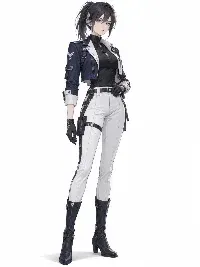
The input was an original AI-created female sci-fi operative illustration: black tied-back hair, a navy cropped tactical jacket, white pants and dark accessories. Only a front three-quarter view was supplied; there was no reference image showing the back.
The generated front and back
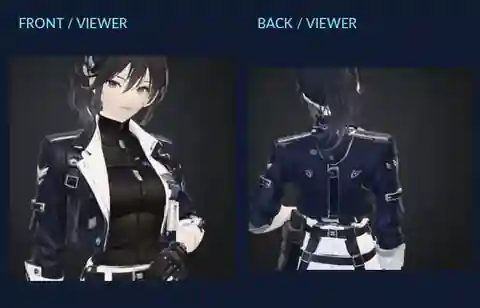
The two images below are cropped screenshots of the actual Meshy 3D viewer. They have been resized for the website, but the character's facial features, outfit and generated geometry were not redrawn or AI-enhanced.
What the model inferred
The reference did not show the reverse of the outfit. Yet the generated back includes jacket seams and straps, belt details, the continuation of the hairstyle, and a plausible arrangement for accessories around the waist. This demonstrates a model filling in unseen design information—not recovering a hidden ground-truth design.
Where it still struggles
The character looks appealing from favorable front angles, but rotating the head changes the impression of the face. Eye shape, facial depth and side-profile consistency remain issues. The screenshots also cannot prove that the mesh is clean, that the back details are physically connected, or that the character will deform well after rigging.
What we'll test next
The next production-oriented step is to compare multiple-angle references and part-by-part generation for faces, hair, garments and accessories. Blender assembly, rigging and motion testing would then reveal problems that a static preview cannot.
Disclosure: This article contains no Meshy affiliate link. AI 3D & Motion Lab is an independent creator project. Other articles on this site may include separately disclosed Tripo affiliate links.